
Effort as Seasoning
In our world of instant gratification, we've lost the sense of effort required to obtain food. A simple click or a quick checkout is enough to fill our cupboards. This ease has a psychological cost: it devalues food and disrupts our reward system. Foraging for your own food in the forest or Scandinavian marshes resets this mechanism. When you spend two hours on your knees in the moss to harvest a handful of wild berries or tracking the golden cap of a chanterelle under fallen leaves, your brain registers the rarity and value of what you hold in your hands. Effort becomes an invisible seasoning that makes the food infinitely more satisfying.
This transformation of the relationship with food has a direct impact on our eating behavior. You don't 'gulp down' a product that took hours to find and prepare. You savor it with renewed attention. This natural mindfulness reduces the risk of emotional overconsumption. You learn to honor the product for what it is: a gift from the earth, not just a commodity. For someone following a low-carb diet, this practice reinforces discipline without conscious effort. Respect for the raw ingredient replaces the need for industrial processing. It's an education of the palate through direct experience with nature.
The Wild Menu
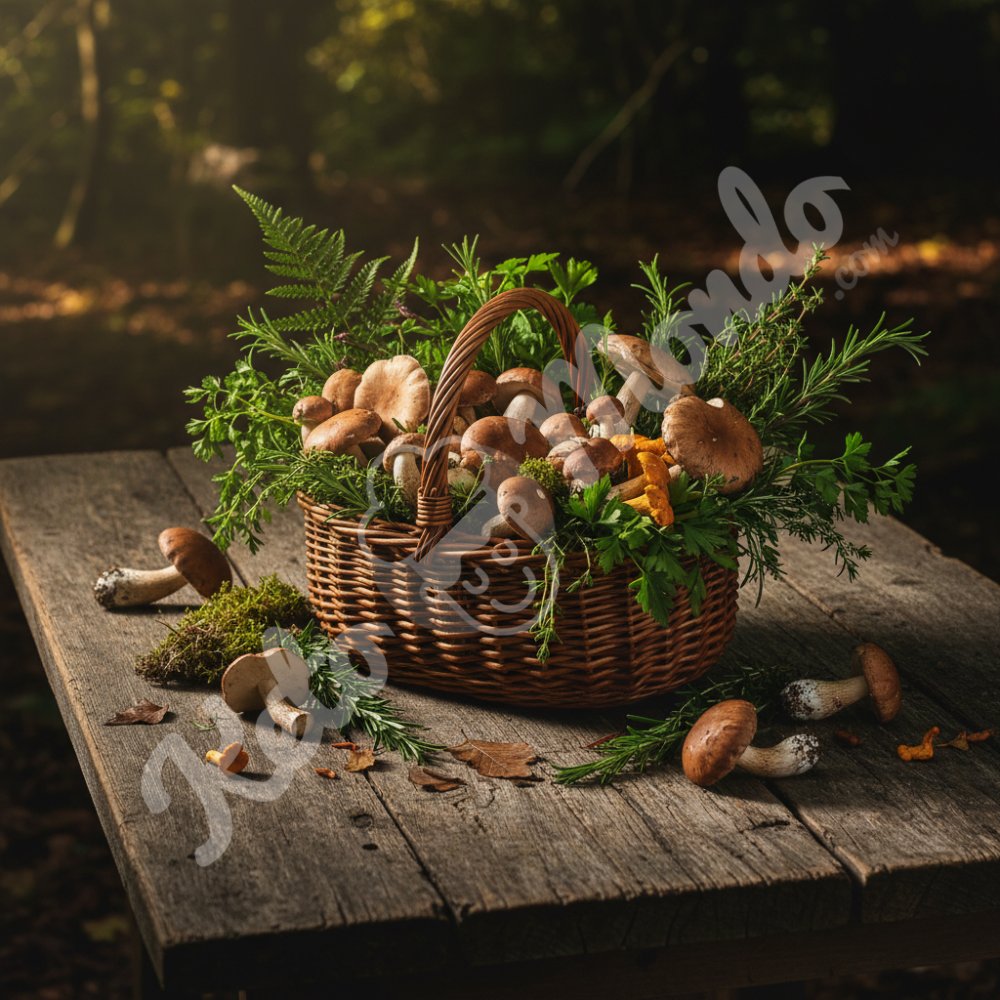
If you observe closely what the Nordic forest offers for foraging, you'll notice a striking absence of concentrated sugars and heavy starches. The wilderness doesn't produce chocolate bars or white bread. It offers mushrooms—true flavor sponges, rich in fiber and minerals, with almost zero glycemic impact. It offers tart berries like lingonberries or cloudberries, whose antioxidant content is inversely proportional to their sugar content. It offers bitter herbs and young fir shoots that stimulate digestion and bring an aromatic complexity found in no supermarket.
By following this 'wild menu,' you naturally align with a low-carb physiology. The forest teaches us that nutritional density is found in small things, in intense flavors and complex structures. It's a lesson in metabolic humility. You realize that your real needs are met by these modest but powerful foods. Mushrooms, for example, provide a meaty texture that satisfies the need for 'chew' without the drawbacks of grains. Wild berries, consumed sparingly, offer a touch of freshness without causing an insulin spike. The forest is the best nutritionist I know; it never lies and never tries to sell you anything.
The Rhythm of the Blood
Foraging imposes a radical seasonality, far from the artificial calendars of modern distribution. You don't forage what you want, but what the earth decides to give at a specific moment. In spring, there's an explosion of greens: sorrel, wild garlic, young nettles. It's the time to cleanse the body after winter, to replenish chlorophyll and minerals. In summer and autumn, it's the time for berries and mushrooms, for preparing stores. This alternation creates a healthy biological rhythm. Our metabolism isn't meant to eat the same thing 365 days a year; it's built to adapt to cycles of abundance and scarcity.
Living by the rhythm of foraging seasons strengthens our resilience. You learn to appreciate the wait. The first chanterelle of the year tastes like victory. This anticipation creates a healthy desire, quite different from the impulse of immediate consumption. You become aware of the passage of time not as a loss, but as an evolution. This temporal connection calms the mind and stabilizes stress hormones. A body that knows food will arrive in its own time, according to the immutable cycles of nature, is a body that doesn't need to store fat out of fear of lack. Living seasonality is the foundation of our inner security.
The Silence of the Woods
Going into the forest to forage isn't a chore; it's a form of active meditation. Your gaze must be both broad to embrace the landscape and precise to spot detail. This focused attention calms the incessant mental chatter. You listen to the cracking of branches, the song of birds, the breath of the wind in the pines. Studies have shown that spending time in the forest significantly reduces cortisol levels, the stress hormone. We know that high cortisol promotes insulin resistance and abdominal fat storage. Foraging is therefore, indirectly, a powerful metabolic regulation tool.
In this silence, you find a clarity that the city steals from us. You're no longer a target for marketing or notifications. You're simply one living being among others, seeking sustenance. This simplicity is therapeutic. It reminds us that we are biological creatures before we are economic agents. After a few hours spent foraging, the mind is washed, thoughts are more fluid. You return home not only with a full basket but with a soothed soul. This inner peace is the best guarantee of conscious eating. You no longer eat to fill an emotional void, but to nourish a rediscovered vitality.
Foraging as an Act of Resistance
Finally, foraging is a political and philosophical act. It's a way of saying no to the standardization of taste and industrial dependence. By learning to recognize the edible plants of our territory, we reclaim a sovereignty we had delegated to multinationals. We step out of the system of added sugars, preservatives, and plastic packaging. Foraged food is pure food, whose exact origin is known. It's the most radical form of 'short circuit.' It's also a way of preserving ancestral knowledge that risks disappearing with our generation.
Every act of foraging is a transmission. It's honoring the memory of those who, before us, survived thanks to this knowledge. It's also a commitment to protecting nature: we only protect what we know and what nourishes us. By integrating foraging into our lifestyle, we become guardians of our environment. We understand that our health is inseparable from the health of the soil and the forest. It's a global vision of nutrition, where the plate is only the last link in a chain of respect and gratitude. Foraging is ultimately learning to receive what life offers us, with humility and discernment.